To solve man-made hunger, we need to stop starving people
Alma Igra
The person who founded the United Nations Food and Agriculture Organization, John Boyd Orr, wrote in the 1950s that when people die of hunger, they don’t die quietly. That’s not true. He knew it too, and certainly from a fairly fresh memory. Anyone who lived in the 1950s carries in memory images of people who died of starvation, images that most of the world was silent about in real time and strongly opposed them after the fact. What may be true is that people who are dying of hunger try not to die quietly. They try to make a voice of protest, and many times no one listens.
Of all the famines that occurred in World War II, the most peculiar was the Dutch famine. It was not the largest of its kind in the war, but it was unique because never before had so many white, wealthy and educated people starved to death. The famine in Holland was a famine of the whole of Holland. 2.6 million people starved in Holland in the winter of 1944-1945, twenty thousand of whom died of starvation during that period alone. It took place in one of the richest and most connected countries in Europe, and in one of the best economic times it had. It was a famine in the first department. It was recorded in advanced hospitals, with equipment that people in Poland and Russia, who were also starving during the war, could not even dream of.
Like many cases of mass starvation, the events in the Netherlands also involved a military decision to starve. Nazi forces imposed a months-long blockade that cut off supply chains to the western Netherlands, in an attempt to break local resistance forces. The blockade was accompanied by a prolonged collapse of the food system, at least in part not planned or initiated by the Germans. A rail strike declared by the Dutch government-in-exile in September 1944, which began as a measure of resistance to push the Wehrmacht forces out of the western Netherlands, developed into a total transport and supply crisis. This crisis completely cut off urban areas in the western Netherlands from food, transport, fuel, cooking gas, and even mail. All this was accompanied by failures to warn of famine and pressure the Allies to allow supplies to enter.
Starvation is a cruel and ugly death. People want to avoid dying of hunger in silence. The Dutch did not want to die of hunger in silence either, but the world did not want to hear. At one point, Queen Wilhelmina, the Queen of the Netherlands, went on the BBC to directly address the British public and try to stir them to action. It did not work. It was not Britain or the United States, the Allies, that starved the Netherlands, but they knew in real time that millions of Dutch people were hungry and did not act to stop the starvation. The Allies wanted to put economic pressure on the Germans and deny them access to fuel and other goods that could aid their war effort. Thus, parts of the western Netherlands found themselves under a double blockade, both by the Wehrmacht, who thought starvation would be a pressure mechanism on the Dutch, and by the Allies, who thought the blockade would make it militarily difficult for the Germans. The Netherlands suffered from the war crimes of the Wehrmacht, from the Allies’ tactical disregard for the famine, and from the failures of its leadership, which at this stage of the war was in exile in London. The Germans used the famine as a tool to promote political decision-making. The enablers and bystanders let the food system collapse and ignored the scale of the disaster in real time.
The possibility of bringing food into the Netherlands came up repeatedly in British cabinet discussions during the winter of 1944-1945, but its leaders preferred military objectives, primarily preventing supplies from the Nazi forces. This happened even though throughout the war, it was clear that Britain treated the Dutch differently than it did the peoples of Eastern Europe, for example. Within the British concept that ranked the peoples of the world according to hierarchies of race and cultural and technological advancement, the British leadership saw the Dutch as equals. The Netherlands, like Britain, was a large European empire that operated in the form of a colonial monarchy. From the British public’s perspective, they were better off not starving. Yet, as the goals of the war were not aligned with ending the famine crisis, the British knowingly let 2.6 million Dutch people starve.
People want to avoid dying of hunger in silence. But those who starve or enable starvation find creative ways not to hear. One way not to hear was to drop aid from the sky. Dropping food is a beautiful thing. It photographs beautifully. The Dutch national memory is full of images of food being dropped from the sky and people cheering in the streets, holding handkerchiefs and flags. The wealthy arena of Western Europe was one with advanced cameras and a press, and the images of manna falling from the sky were captivating, both for the desperate Dutch population and for the Allies, who wanted to stop hearing about famine. Britain did indeed call this food drop “Operation Manna” and the biblical dimension of the operation also appears in memoirs and discourses about the war. Food falling from the sky is a miracle.
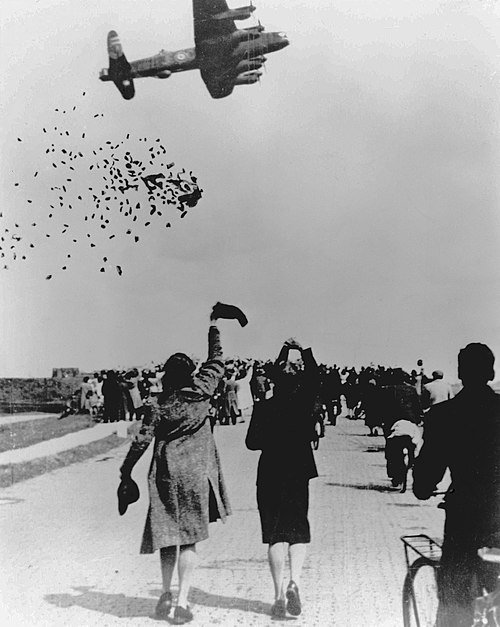
But the food drop didn’t really work. The quantities of food were insufficient, and the infrastructure needed to feed them didn’t exist or failed. The food drop wasn’t accompanied by the distribution system required in times of famine, one that would allow for prioritization of particularly vulnerable populations, such as the elderly and children. When a person is starving, they need medical support, not just an unlimited amount of food. Sometimes, the transition from starvation to gluttony can put the body into a coma and kill it.
Ironically, the Americans called their food drop in the Netherlands “Operation Chowhound,” and indeed, the fast eating took its toll. The food drop was very exciting and photographed well, but its impact was negligible. That did not prevent it from becoming iconic. In any case, about a week after the highly publicized operation, the Germans were defeated, and the population in the western Netherlands did enter a process of rehabilitation, which included medical treatments essential to a body in a state of starvation.
In fact, there is no recorded case in human history where throwing food on people’s heads, from the sky, while someone is working to starve those people right on the ground, has saved them from starvation. The reason is simple: food involves a whole set of logistics, cooking, refrigeration, transportation, and distribution. For food to become food, that is, to reach those who need it, extensive networks of human, technological, and ecological relationships are required. Intentional starvation harms this complex in all its aspects.
This is why airdropping food, as has been tried on the Gaza Strip several times during two years of war, is not a solution – it is a public relations exercise. They will drop flour and there will be no place to bake the bread. They will drop powdered food and there will be no access to boiled drinking water. They will drop it in one place and in another people will die. They will drop it on someone who is so severely starved that the mere act of eating at this stage will kill her. What is a family supposed to do if pasta is dropped on them from the sky, but there is no kitchen and no way to distribute it to the family, no electricity, no table, no plate, no running water, and no way to plan how much to eat today, because there is no certainty that there will be anything to eat tomorrow.
Food is something that exists as such only within a whole fabric. Therefore, when you destroy an entire fabric of life, when you carry out a brutal attack through bombings, diseases, mass shootings, the destruction of all hospitals, the murder of aid workers, the burning and razing of houses, the manna falling from the sky does not change the hunger. Murder through starvation is especially cruel because at a stage where everything is already being destroyed, food alone will not save anybody. Certainly not in the essential sense, but not from hunger, either.
The IDF announced a few weeks ago that even though there is no famine in the Gaza Strip, they will allow food airdrops. Another tiresome irony from the makers of “the hostages suffer, but they don’t die” and “one step away from absolute victory.” It is possible that the food airdrops are nothing more than a PR move to change world’s public opinion, and it is possible that the images of famine have shocked quite a few people in the military leadership, as well. In any case, it must be said honestly that the chances of this being useful to hungry people are very low. In fact, it mainly serves those who are trying to buy time and not hear. Humanitarian aid in wartime is a very complicated thing logistically (the kitchen, the water, the distribution, the refrigeration, the transportation), and even more complicated politically. You can’t simultaneously try to kill everyone and try not to kill them.
The Dutch famine winter teaches us that even when it was not about distant colonies, or black, brown, Asian, or the poor people in Eastern Europe – those who want to let people starve to death will say they can’t hear. It also teaches us that armies waging wars will often prioritize tactical considerations over other considerations. In fact, both the Germans and the British chose to continue the Dutch famine until it no longer suited them militarily. The same will happen in Gaza. Once starvation has become one of the tools of the war and the world does almost nothing but waves its finger, no one in the Israeli American axis that is causing it will give up this tool. Therefore, the only way to stop the famine crisis in Gaza is to stop the war it serves.
Dr. Alma Igra is a senior lecturer in the Department of European Studies at University of Amsterdam. Her research focuses on the history of hunger, nutrition, and the international regulation of food.
Additional reading:
Zwarte, Ingrid de. The Hunger Winter: Fighting Famine in the Occupied Netherlands, 1944-1945. Cambridge University Press, 2020.
Zwarte, Ingrid de, and Miguel Ángel del Arco Blanco. “The Allied Blockade and British Politics of Food and Famine during World War II.” In The Politics of Famine in European History and Memory. Routledge, 2025.