
Hunger in Gaza, Based on Israeli Data
Dan Glück
Translation: Itamar Haritan
In this article, I substantiate the claim that Israel deliberately starved the population of Gaza (based on data collected up to the end of July 2025). I will do so using Israeli sources only, and specifically data provided by the Israeli security establishment. This approach differs from that of the central document on the “Witnessing the Gaza War” website, which relies on a variety of Palestinian and international sources.
In this article, I will support the following claims: 1) As of late July 2025, there is severe hunger in the Gaza Strip; 2) Israel has deliberately starved the Gaza Strip; 3) as on previous occasions when Israel starved the Gazans, it stopped due to international pressure; 4) there is no evidence that Hamas is causing starvation in the Gaza Strip, while there is clear evidence of Israel’s role in doing so.
Further, I show that the Israeli newspaper Haaretz, international newspapers, international professional bodies, and professional Palestinian medical bodies have been reliable in their reporting on the Gaza Strip, and that they have been much more so than the Israeli mainstream media, the Israeli security establishment, and the Israeli government. Statements from non-professional figures at the UN, such as the UN Secretary-General, have not always been reliable either.
On July 27, following significant international pressure, Israel began allowing more food aid into the Gaza Strip than the bare minimum required, in order to ease the starvation that was caused there.
As of late July 2025, there is severe hunger in the Gaza Strip.
The most important piece of evidence for the existence of widespread hunger – evidence which all sides (including the IDF spokesperson) confirm – is that people are willing to risk their lives for a sack of flour, and have been doing so every day for several months.
Food prices in the Gaza Strip are another important piece of evidence indicating the presence of severe hunger. According to an Israeli study published in the Israeli press – including by a key journalist and an enthusiastic supporter of the Israeli government no less – the price of a 25-kilogram sack of flour reached 2,500 to 5,000 shekels by the end of July. This would be equivalent to 2-5 months of the average prewar salary in Gaza.
It is true that some of the photos of hungry children in Gaza are of children with underlying illnesses. However, this is clearly explained by the fact that these children are more vulnerable than others. It does not mean that only these children are affected by starvation, and it certainly does not indicate that there is no starvation. Similarly, some photos depict emaciated children alongside other family members who look less emaciated. However, this does not mean that there is no hunger either. After all, children generally have little in the way of bodily reserves and are thus the first to succumb to starvation.
Photos of food in markets and cafés also do not disprove the hunger claim: Even in the Warsaw Ghetto during the Holocaust, there are photos of food stalls alongside photos of people starving on the sidewalk, captured on the same day. When a food shortage occurs, the poor and the weak have a much harder time obtaining food than the strong. Furthermore, due to the wartime conditions, food distribution in the Gaza Strip has been and continues to be uneven. This unevenness has been even more pronounced since the Gaza Humanitarian Foundation (GHF) began its operations. This means that one area can experience hunger even as another area has sufficient food. Since movement in the Strip is severely limited due to the fighting, it is exceedingly difficult to move food between different areas of the Strip.
Gaza is being starved intentionally.
According to data provided by the Israeli security establishment, on March 2, 2025, Israel completely halted the entry of food into the Strip. It only partially resumed the movement of food in May through the “Gaza Humanitarian Foundation” (GHF). The GHF distributes food in four distribution centers which are located several kilometers away from population centers.
International experts and professional bodies concerned with humanitarian aid warned as early as mid-May that this distribution plan will spell disaster for several reasons: The Israeli security establishment’s plan would place food distribution sites far from residential areas, which would require residents to walk very long distances through combat zones (where they are exposed both to army attacks and to looting of aid deliveries by armed men); food would not be distributed according to families or eligibility lists, so the strongest can take more food than they need; on the other hand, the disabled, the wounded, the sick and the elderly will have great difficulty obtaining food in this way. This means that even if a theoretically sufficient amount of food were allowed entry, this plan would still cause hunger among some residents of the Gaza Strip. These claims suggest that even if the amount of distributed food had been sufficient, partial hunger would still have unfolded in the Gaza strip. In reality, the total amount of food that was actually allowed into the Gaza Strip was significantly lower than the theoretical minimum requirement.
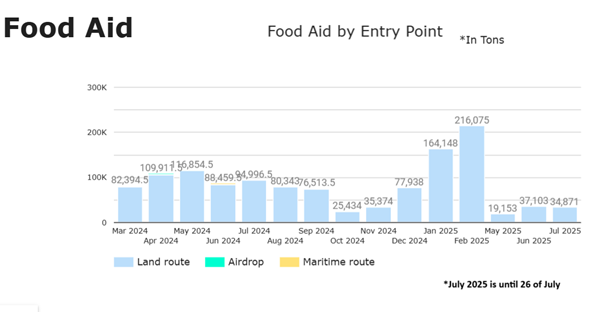
A study conducted by senior officials in the Israeli Health ministry in partnership with other Israeli researchers confirms the above claim. In this study, the researchers calculated the amount of food that must be transferred to the Gaza Strip each month to achieve the accepted humanitarian minimum. It follows from the study that the minimum is more than 50,000 tonnes of food per month (according to the method used in Israeli security establishment reports to calculate food aid weight).1According to the study, 68,000 tonnes of food per month is 1.5 times the minimum required to feed the residents of the Gaza Strip. Thus, the minimum is about 45,000 tonnes of food per month. However, the study also estimates that the net food quantities that actually end up entering the Strip are about 15% lower than what is reported by the Israeli security establishment (and possibly even less). This is because the reported weight includes packaging, among other factors. For that reason, it can be estimated that more than 50,000 tonnes of food are required per month, as calculated in Israeli security establishment reports. In fact, it can be claimed that even a greater number of calories than this minimum is required during wartime due to injuries, the need to move from place to place, etc. However, according to Israeli security establishment reports, from mid-May to July 26, only about 40,000 tonnes of food per month were allowed entry, as can be seen in the graph below. Only starting July 27 was there a significant increase in food entry.
Taken together, these findings indicate that no food was transferred into the Gaza Strip at all for two and a half months, and that for another two and a half months subsequently, food was transferred at an amount significantly below the required humanitarian minimum.
An argument often raised against such analyses is that the Gaza Strip has enough food left over in warehouses, and therefore a shortage in food transfers to the Strip should not cause hunger. However, no evidence has ever been presented that the Gaza strip possesses food stores in sufficient quantities. After two years of war, during which a very high percentage of the buildings in the Strip have been damaged, and for long periods the entry of food was highly limited, it is unlikely that significant food stores remain. The same is true regarding food stockpiled during the last ceasefire (January-February 2025). These reserves were likely depleted during the two and a half months after the ceasefire in which no food was allowed entry at all (March to May 2025). Indeed, the IDF and senior Israeli officials both estimated that Gaza’s food stores would run out by May 2025.
This means that all relevant actors in the State of Israel – the Prime Minister, government ministers, senior IDF officials, the Coordinator of Government Activities in the Territories (COGAT), and even senior officials in the Ministry of Health – knew (or should have known) that the food distribution plan would lead to starvation. The actors involved in this decision thus deliberately starved the Gaza Strip. This conclusion is consistent with the fact that Israeli media figures and Knesset (the Israeli parliament) members in the governing coalition have consistently and publicly supported the starving of Gazans, even children.
This is not the first time that Israel has starved the Gazans. In each of the previous times, Israel only stopped following international pressure.
The aforementioned study by Israeli health researchers presents data provided by the Israeli security establishment. According to this data, in January-February 2024 only about 100 tonnes of food were allowed into the northern Gaza Strip. At that time, between 150,000 and 300,000 civilians were living there, or between 7% and 14% of all Gaza residents. Recall that the above study has found that a minimum of more than 50,000 tonnes per month is required to feed the entire Gaza Strip. Based on this calculation, at least 3,500 to 7,000 tonnes of food per month would have been needed to feed the northern Gaza Strip during this period. In other words, the amount of food transferred to the northern Gaza Strip over that two-month period was 70 to 140 times less than the required minimum. Furthermore, according to the IDF, this period came following Hamas’ military defeat in the northern Gaza Strip (but not in the rest of the Gaza Strip). This means that the starvation of the north was an Israeli government decision made regardless of Hamas’ actions on the ground. According to Israeli sources, this period of starvation ended only after US pressure had been applied.
Another period of starvation was in October-November 2024 and took place in the entire Gaza Strip. Looking at the graph above, which is composed of the Israeli security establishment’s own data (i.e. COGAT), it is clear that in this period too, the amount of food that reached the Gaza Strip was significantly lower than the required minimum of more than 50,000 tonnes per month. According to Israeli sources, this shortage was deliberately created as part of a plan for a total blockade of the northern Gaza Strip. This blockade was imposed as part of the possible implementation of the so-called “Generals’ Plan,” and ostensibly even as an attempt to execute the plan in practice. Then too, Israel only began allowing the entry of larger quantities of food in response to international pressure, and in particular to the US threat of an embargo.
The most recent period of starvation, which I described above, also ended due to international pressure. This period began following the collapse of the ceasefire in early March 2025. Since that time, no food was transferred into the Gaza Strip at all until mid-May according to Israeli security establishment data, though at first there remained food stores stockpiled in significant areas of Gaza during the January-February 2025 ceasefire period. This time too, Israel only restarted food transfers to the Strip following international pressure, particularly from Trump. However, as mentioned above, Israel conducted these food transfers in part through the “Gaza Humanitarian Foundation” (GHF), and did so on a very limited scale until almost the end of July. Israel increased the quantities of food allowed into the Strip in recent weeks (starting at the end of July 2025) following international pressure, including US pressure.
There is no evidence that Hamas is causing widespread hunger in the Gaza Strip.
A common claim in Israeli public discourse is that Hamas’s taking control of food distributed in the Gaza Strip proves that it is starving the population, or that this seizure of food supplies constitutes “theft.” This claim is false. Hamas (to the extent that it is still able to govern) is the government in Gaza, and therefore it is to be expected that it would try to control the distribution of food there for various reasons, including to prevent looting by gangs and to ensure a fair food distribution. Contrary to Israel’s claims, Israeli sources have reported cases in which Hamas shoots at food looters,2The warehouse mentioned in the linked article belongs to the UN, not Hamas. and not at civilians seeking food in an orderly manner.
Whenever armed men loot food in the Gaza Strip, the Israeli media claims that they are Hamas members rather than other armed gangs without providing any evidence. During humanitarian disasters in general, armed people eat better than unarmed people. Israeli sources have reported that governance in Gaza is unstable, and that various armed gangs control different areas; some are affiliated with Hamas, others are not, and some are supported by Israel. The fact that these gangs control food distribution in certain areas and eat better than the rest of the population is a situation that even the Hamas leadership cannot prevent, whether it wants to or not. In fact, the food shortage created by Israel, as well as its destruction of Hamas’ governing institutions, both contribute to food looting by such gangs.
Regarding the claim that Hamas is systematically stealing food, senior IDF officials recently admitted that there is no evidence for this. This admission was confirmed by the US administration. Documents published by the IDF on the subject also show that the vast majority of the aid was not taken by Hamas.
Furthermore, the main claim made by senior Israeli officials regarding Hamas’ takeover of food is not that Hamas is destroying or hoarding food without using it, but rather that it distributes the food to the population (thus strengthening its rule), or that it sells it (thus making money). The IDF claims that Hamas sells the food or uses it to feed its people. Such actions would not cause a food shortage if a severe shortage did not already exist.
Prof. Danny Orbach recently laid out Israel’s position on the subject, presenting irrelevant evidence as proof that “Hamas is stealing aid.” For example, he pointed to the fact that Hamas members have been found to be in possession of UN food boxes. The truth, however, is that every person in the Strip – even if they happen to be a Hamas member – receives food from the UN. This is because the UN distributes food to the entire population.
Reports in the Israeli media about “fully-stocked Hamas food warehouses” do not correspond to the periods and places that UN reports identify as having experienced severe hunger. Even when soldiers report seeing stocked food warehouses or when they distribute videos about them, these can only relate to specific places and times, and not to the emergence of hunger elsewhere and at other points in time.
UN reports about actual starvation on the ground also support the claim that Israel, and not Hamas, is the cause of the hunger. As will be explained below, these reports are consistent with IDF-confirmed evidence of extreme hunger in the Gaza Strip. In April 2025, a month after the ceasefire collapsed, Israel had already stopped allowing the entry of food into the Strip. However, this period came after a two-month ceasefire in which a lot of food had been transferred to the Gaza Strip and was stockpiled there. According to UN reports, this period saw an improvement in the hunger situation in the Gaza Strip compared to the period before the ceasefire. This means that the residents of the Gaza Strip as a whole had access to the warehouses where food had been stockpiled during the ceasefire period – a period during which Hamas had relative freedom of action. In contrast, in January-February 2024 in the northern Gaza Strip, Hamas suffered a serious military defeat and retreated to the tunnels (leaving the area under effective Israeli control). It was actually in this period, when Hamas was not in control of northern Gaza, that severe hunger developed in the area.
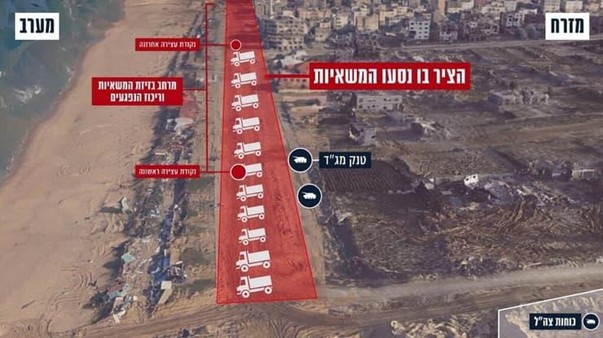
Thus, the evidence points to the fact that Israel, not Hamas, caused the starvation. This is because the periods of particularly severe hunger correspond to the periods when Israel starved the Gaza Strip by not allowing the entry of sufficient food. Indeed, the two periods that Israeli security establishment data identify as peak periods of starvation in the Gaza Strip – January-February 2024 in northern Gaza and March to July 2025 in the entire Gaza Strip – correspond not only to the severe hunger documented in UN reports by the end of both periods, but also to IDF-reported events that indicate severe hunger: At the end of the first period, in February 2024 in the northern Gaza Strip, the IDF acknowledged the al-Rashid Street humanitarian aid disaster, which occurred when a huge crowd surrounded several aid trucks, leading to panic and shooting at the crowd, and ultimately to dozens of deaths. In the latter part of the second period, in June-July 2025, IDF reports and accounts given by IDF field commanders confirm that thousands of Palestinians were willing to risk their lives repeatedly to obtain food.
Reliability of Israeli and international media outlets:
As a general rule, the main Israeli media outlets – with the exception of the newspaper “Haaretz” – refrain from reporting on hunger in the Gaza Strip. When they do report on it, they almost always frame it as “claims that there is hunger,” and not as hunger that actually exists. Also, responsibility for the hunger is attributed to Hamas. In other words, the vast majority of journalists in Israel deny the existence of the Israeli starvation policy. Recent reporting has emerged detailing self-censorship on the subject in Israel’s Channel 12, whose news program is the most popular in Israel. Among the factors driving this self-censorship is the claim that such reporting would cause “demoralization.”
Even well-regarded journalists have been party to such self-censorship. For example, in a piece by the Israeli journalist Nadav Eyal, the author describes how Gazan civilians are killed trying to obtain food (a detail that implicitly confirms the presence of hunger in the Strip). However, Eyal goes on to discuss a document written by Prof. Danny Orbach and several others claiming that “there is no basis for the starvation claim against Israel.” It is true that this is what the authors argue, and the document focuses on disproving statements (which were indeed incorrect) by the UN Secretary-General about the need for the entry of 500 aid trucks a day. However, in the very same document, Orbach and his co-authors admit that Israel deliberately starved residents of the Gaza Strip both in the north in January-February 2024,3From the document: “From the end of the ceasefire in December 2023 until March 2024… the entry of many aid convoys into the northern Gaza Strip was prevented or delayed…” The authors of the document also admit that apparently “there was a reduction below the recommended nutritional level for a few weeks.” and in the entire Strip from March to May 2025.
It is important to note that unlike the mainstream Israeli press, reports in the Haaretz newspaper and in trusted international outlets largely correspond to the facts I presented above. To be clear, the above facts derive from the relatively straightforward numerical data provided by the Israeli security establishment itself, and to a lesser extent from Israeli mainstream press reports (especially those quoting Israeli security officials).
Reliability of international and Palestinian professional sources:
Data from Western medical professionals and UN data reflect the gap between the amount of food that Israel has allowed into the Gaza Strip according to the Israeli security establishment itself, and the needs of the Gazan population as determined by senior Israeli Health Ministry officials.
The most accurate UN hunger data comes from the IPC, an ongoing UN project that monitors hunger around the world. In the Gaza Strip, this data is largely based on reports from local nurses who examine children. Given the high degree of correspondence between this data, the data provided by Western medical professionals and Israel’s own data, it must be concluded that this is relatively reliable data. It should be noted that these actors do not publish reports only when the situation worsens, but also during other periods when Israel allows more food to enter and the situation improves.
It should also be noted that, as opposed to real-time reports, the IPC’s hunger forecasts were more severe in some cases than what actually ended up taking place. This is because the IPC assumed that the quantities of food that would be allowed to enter would not change. In fact, it was only after these forecasts were published that Israel began allowing more food into the Gaza Strip, both in response to the warnings contained in these forecasts as well as in response to international pressure.
Furthermore, the IPC and Western medical professionals reported severe hunger during two periods in particular. As we have seen above, these are periods in which even IDF sources confirmed that Palestinians were risking their lives to obtain food. This lends credibility to claims regarding the prevalence of hunger on the ground.
Credibility of the IDF and the entire security establishment:
The Israeli security establishment has misled the public about hunger in the Gaza Strip, often by distorting and concealing information. An example of this modus operandi is its response to reports of hunger in the northern Gaza Strip in January-February 2024. In March of that year, it issued a report to the media claiming that the IDF and COGAT ensure the transfer of sufficient food into the Strip. This claim stands in stark contrast to their policy on the ground in the preceding two months, during which they blocked the movement of aid. Israeli media presented this report as a “debunking” of the UN report and as “proof” that Israel is not starving Gaza. In fact, however, the data in this report does not refer to the amount of food brought into the northern Gaza Strip in January-February 2024 – the period to which the UN was referring – but only to the month of March.
In petitions filed by human rights organizations to the Israeli High Court of Justice on the subject of starvation, the state, including the security establishment (COGAT), claimed that “the State of Israel acted throughout with the aim of enabling and facilitating the transfer of humanitarian aid to the civilian population in the Gaza Strip… There are no restrictions on the amount of humanitarian aid that can be brought into the Gaza Strip… [The] policy… is not derived from this or that figure… but is derived from the premise that humanitarian aid, and food in particular, should be allowed to enter without quantitative restrictions.” This claim was in complete contradiction to their policy on the ground, both according to Israeli security establishment data and other on-the-ground signs that plans for a siege were being implemented. Indeed, some of these siege plans were discussed publicly, while others were even formally adopted by the government. This attests to the low degree of reliability of statements by the state of Israel and the Israeli security establishment, even in the context of court proceedings.
I will not address the credibility of the IDF spokesperson’s media statements in detail here. However, it should be noted that according to the IDF Spokesperson Unit itself, its role is not to report the truth, but to “strengthen public trust in the IDF, strengthen the legitimacy of its activities and deter the enemy.” The IDF Spokesperson Unit has conducted intentional disinformation operations in the past. Expecting an IDF spokesperson to be credible is like expecting a general to tell the truth about his plans to surprise the enemy. That the IDF spokesperson is not credible is legitimate and understandable; what is not legitimate is the fact that the Israeli media and the Israeli public take the IDF spokesperson’s statements as the absolute truth.
In this context, it is worth mentioning that the Israeli High Court bears responsibility when it does not intervene on the issue of starvation – whether by continuously avoiding consideration of it, endorsing its official statements without scrutiny, or justifying state actions in almost any area if it has an ostensible connection to security.
To sum up: Again and again, Israel has caused severe hunger in the Gaza Strip. The Israeli media does not report on it, and sometimes even lies about it, apparently for reasons of “patriotism.” The credibility of the Israeli security establishment on the issue is also very low, while the credibility of international professionals is relatively high.
Dan Glück served nine years in the IDF, six of them as an officer. Later, he worked for several years in the Israeli defense industry. Glück has a PhD in physics and has years of professional experience in statistics and data collection.