In Two Years of War, Dr. Muath Abu Rukba Saved Thousands of Animals. He Was Killed the Day It Ended
By: D.B.
Translation: Inbar Yekuel
Dr. Mu’ath Tal‘at Abu Rukba survived two years of a war of annihilation. He was a young veterinarian, one of the few in the besieged Gaza Strip that were still operating in the northern Strip during the final stages of the war, before the evacuation of Gaza City during the operation to occupy it, beginning August 14, 2025. Dr. Muath was murdered on October 10th, the day the ceasefire went into effect. He thought that his home in Jabalia was in the safe zone, meaning inside the “Yellow Line”, that is, the IDF’s initial withdrawal line, as part of the first stage of the ceasefire agreement. That Friday morning, he set out to check what was left of his home and fetch some of his and his family’s belongings. He never came back from this short trip. He left behind his wife, Rania, and two children: Yousef, 3 years old, and Tal’at, 20 months old at the time.
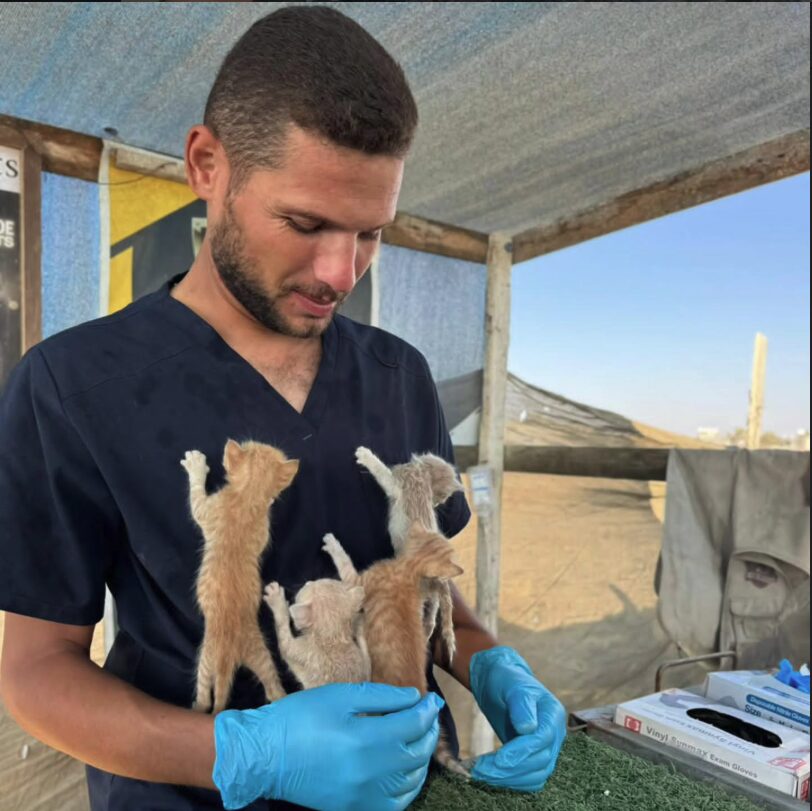
Dr. Mu’ath, as he is known to his followers on social media, was the head veterinary surgeon at Sulala – the only non-profit animal rescue in the Gaza Strip, which began operating before the war and continued throughout it. The organization treated thousands of dogs and cats, and dozens, if not hundreds, of horses, donkeys, and other animals. Dr. Muath worked closely with the al-‘Err family, which runs the organization, and maintained excellent relations with them. During the war, they became exceptionally close due to the horrible sights they witnessed and the arduous work together in animal shelters in the north and south of the Strip. Saed al-Err paid tribute to him on Instagram, where he said: “Dr. Muath was one of a kind – it’s rare to find a person so kind to people and animals. We would call him often, and he never said no; he was always willing to come and take care of all the animals. We are deeply sorry for the loss of Dr. Muath, may Allah have mercy on his soul, and wish his family to find solace.”
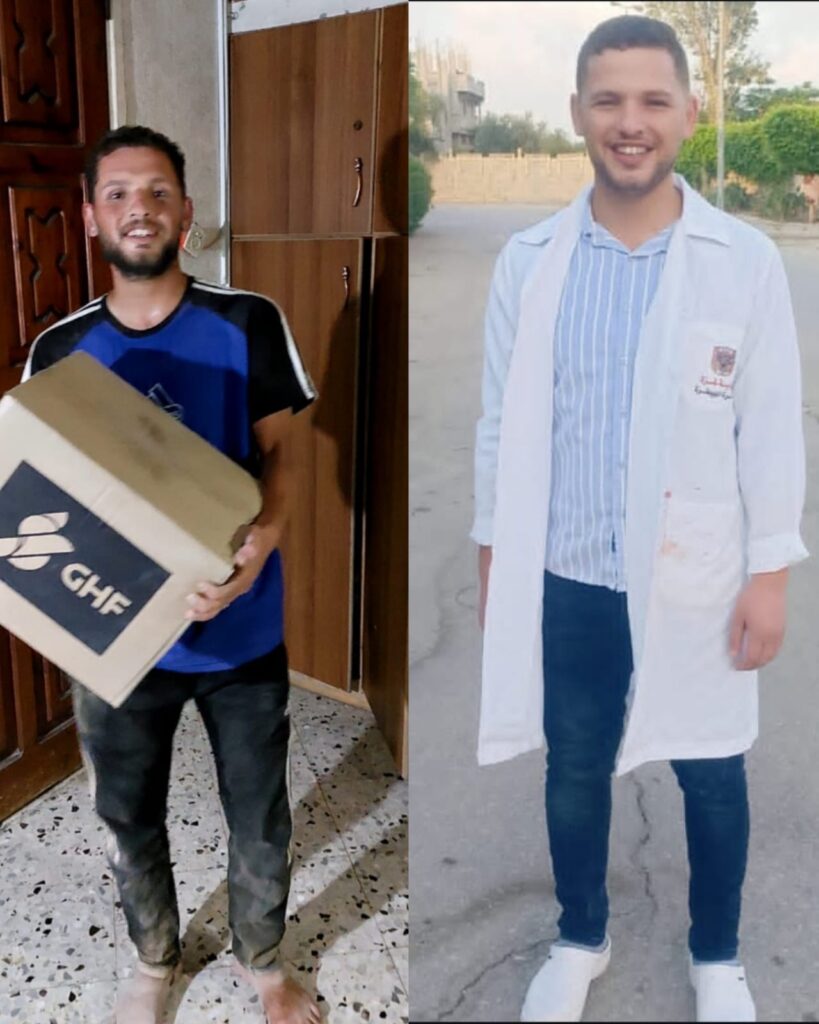
Much can be learned from Dr. Muath’s Instagram profile about the kind of person he was. His father passed away in November 2016, and his grandfather in April 2017. He seemed to have loved them very much. As many others in Gaza did, he left the Strip to go to university in Egypt in 2016, and probably missed their funerals. Beside a picture of him in Rafah Crossing, he wrote the date February 13, 2016, and added a broken heart emoji. In the comments, his friends ask whether he has already returned from Egypt, and one of them writes that he must have missed Gaza. In 2018, he uploaded a picture of himself next to the pyramids of Giza. He seemed happy. He graduated from Zagazig University in Egypt in October 2019.
The origin of his family can be identified from the epitaphs on his father’s and grandfather’s graves, which Dr. Muath uploaded to his Instagram. According to the epitaph, his family’s origin is in the displaced Palestinian village of Dimra. On top of Dimra’s ruins, Kibbutz Erez was established, just 12 kilometers north-east of Gaza.
He worked as a veterinarian for the Gaza slaughterhouse and later in its veterinary department. In June 2023, he opened his clinic in the Rimal neighborhood of Gaza City and subsequently worked independently. He uploaded to his Instagram account videos of himself performing sterilization, castrations, operations, C-sections, draining ulcers, and putting limbs in casts. Right at the beginning of the war, his clinic was destroyed. He wrote: “Only in Gaza, the dream was gone before it even started. Our clinic, which we opened just four months ago, was destroyed.” In March 2025, he reopened his clinic inside a pet shop. Gazans do what they must to survive.
He first tagged his wife Rania in December 2019. According to her profile, she was born in 1999. Dr. Muath shared a video of their wedding from February 2022. Rania is now almost 26 years old. She is a pharmacist, the mother of two, and a widow.
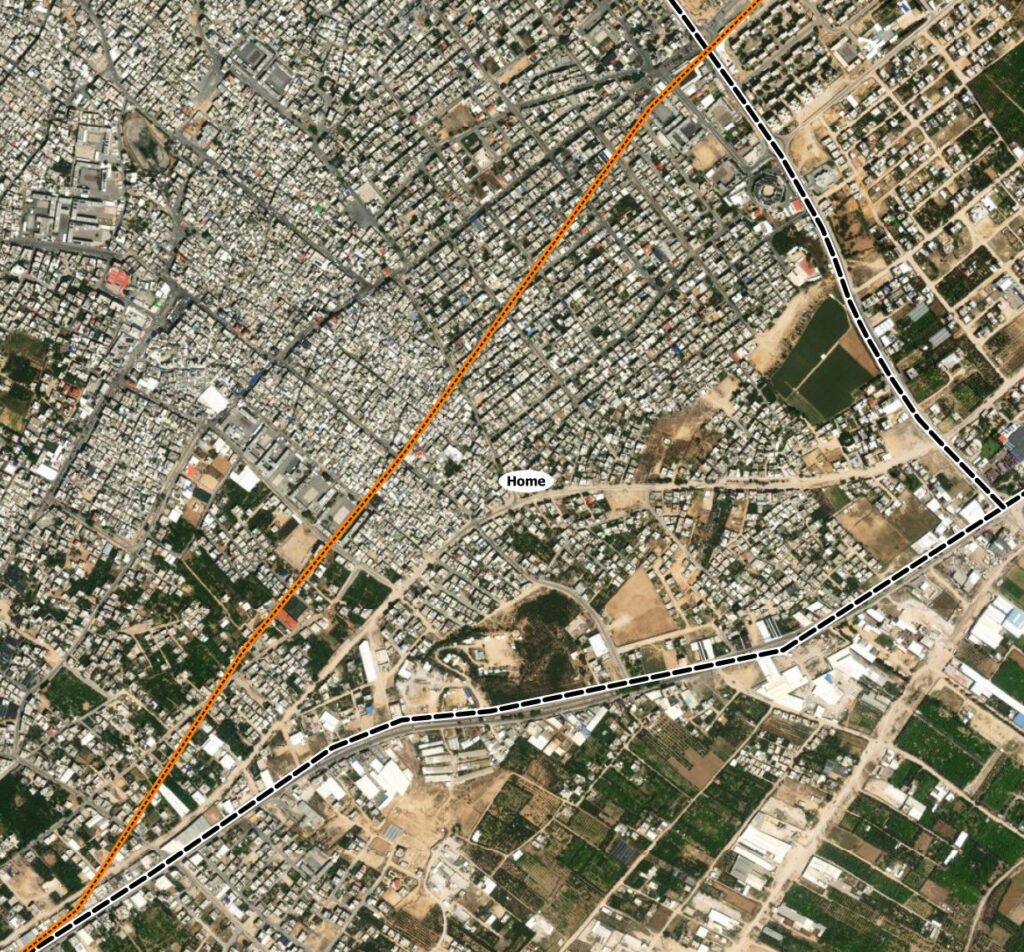
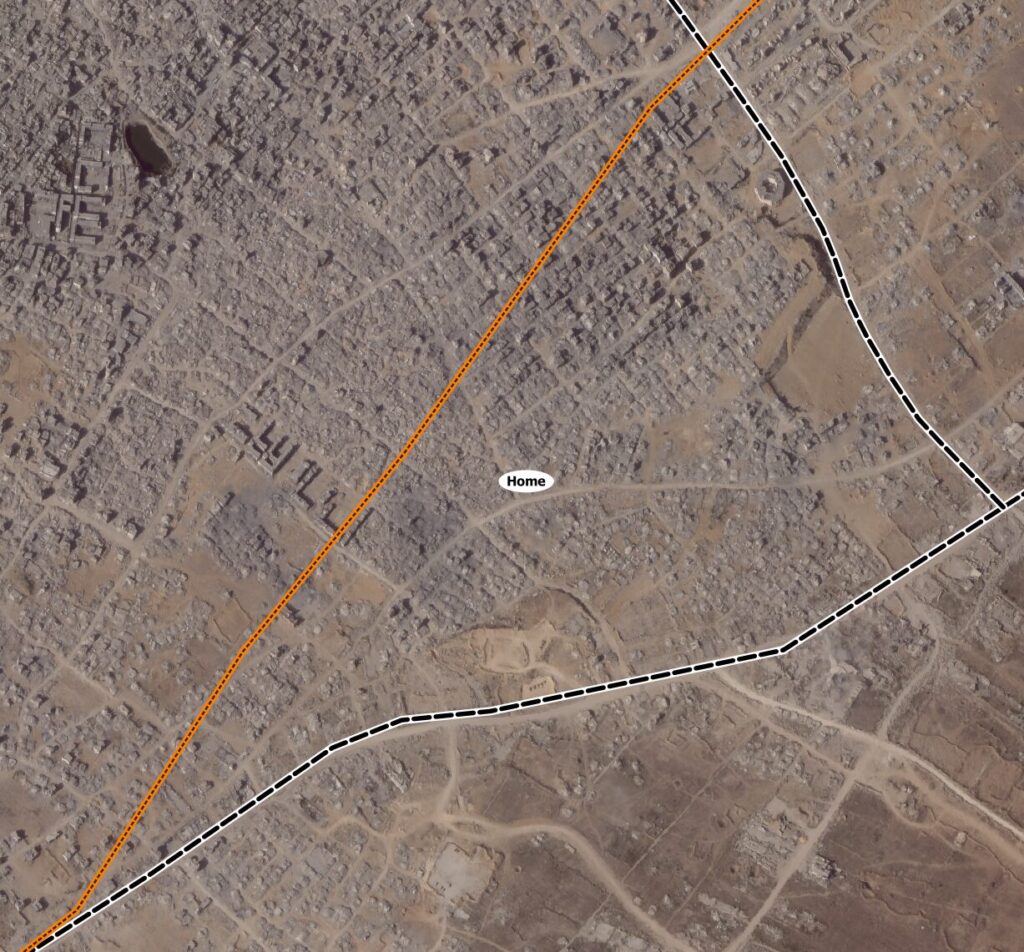
In late 2024, especially after the ceasefire between January and March 2025 began, he shared pictures of his and Rania’s house and the daycare operating beneath it – before and after it was utterly destroyed. I found the daycare’s Facebook page, through which, the approximate address and location of Dr. Muath’s home. Looking at the map of the “Yellow Line”, meaning the line to which Israeli troops withdrew on a map in the afternoon of Friday, October 10th, 2025, Salah A-Din Street marks the majority of the path of the Yellow Line, except for the northmost part, which sits between Jabalia refugee camp and Beit Lahia. This is exactly the section where Muath’s and Rania’s house was located.
How are ordinary people supposed to decode the army’s misleading maps? The case of Dr. Muath Abu Rukba, whose death received some media coverage, is a rare and unusually clear testimony to the difficulty the people of Gaza face as they try to decipher how the instructions or the ceasefire agreements pertain to their daily lives. But there were many others like Dr. Muath, who believed that when the ceasefire was announced, they could return to their homes or visit them, fetch their belongings, clothes, and equipment – only to be surprised by a bullet or a bomb dropped from above. Just as Dr. Muath, others crossed an unnamed “imaginary line” that, once crossed, could lead to being shot. Last August, leading towards the reoccupation of Gaza City, the army directed the displaced population into areas it had defined as dangerous and forbidden. In the morning, Muath went missing. During the withdrawal, the IDF published a map that it later claimed was meant “for illustration only.” This must have been the map Muath relied on when he set out on his final journey.
A reconstruction of the map published in the morning of October 10th, and the marking of the Yellow Line with satellite images, Muath’s and Rania’s house does seem to be located between the two lines the morning Muath went there and never came back – the Yellow Line according to the map from the morning of October 10th, and the Yellow Line as it was practically enforced that day (marked in the map below in orange). It also seems that not far from their house, behind a rampart, Israeli tanks were overlooking the house.
Testimonies show that the IDF controls, de facto, areas beyond the agreed-upon Yellow Line, and that the IDF continues to change the line according to its needs and without updating the population or marking it permanently and clearly on the ground. Since then, there have been more media reports of the IDF shooting civilians identified as “suspects” who approach or cross the Yellow Line. On November 29, 2025, for example, the IDF announced to the media that two “suspects” were committing suspicious activities on the ground and approaching IDF troops operating in the southern Gaza Strip, causing an immediate threat to the soldiers. After the troops spotted them, the IAF, under the troops’ direction, eliminated the suspects to remove the threat. Both suspects identified and “eliminated” were two children, brothers Fadi and Juma Abu Asi, 10 and 12 years old at the time of death. They were helping their wheelchair-ridden father find some firewood.
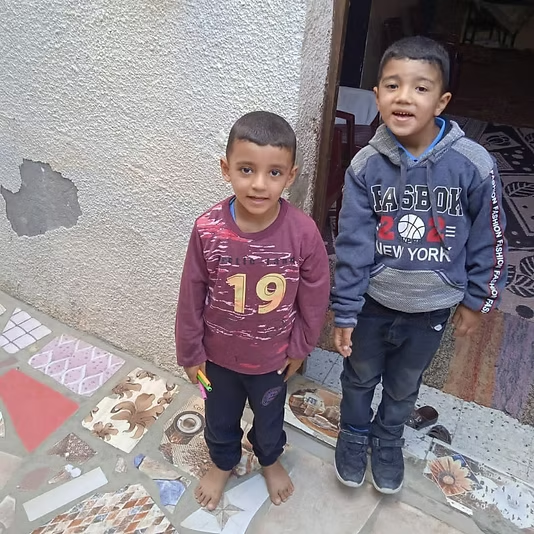
Back to Dr. Muath Abu Rukba, who had been missing for nine days until the identification of his body was confirmed. During this time, the members of Sulala, activists, and organizations shared the call to trace him and return him to his worried family. Many veterinarians spoke of him and urged others to spread the appeal to search for him or to pass along information about his unavailability. When his brother went looking for him and came close to the house, he saw someone being shot to death in front of him. Dr. Muath’s uncle was also shot when he approached that area.
Last May, Muath uploaded a video of himself, his wife, and their two children riding a donkey-drawn cart. He wrote that this was their 10th time evacuating from Jabalia. How difficult it is, as a veterinarian, to see animals work until they bleed, starving and dehydrated. Throughout the war, he treated animals with limited equipment, medication, and anesthesia, and lacked clean water, specialized animal food, and sufficient food for human beings. In July, he uploaded a picture of himself from before and after the war, and hunger was apparent in his face. “The famine that exhausted our bodies”, he wrote. That was the last post he ever uploaded.
This story is important, not only because we must remember and remind others that Palestinians are human beings, but also to emphasize the importance of personal stories of people in war, including those forcibly called “military-age men”. Dr. Muath left behind a family, colleagues, and thousands of animals he had helped. Complete strangers empathized with his story and saw, through him, what the news can not show. Tracking his story before and after the war and the examination of his death show us the rather arbitrary set of boundaries and lines between diplomacy and military tactics, and their relationship to the imagination of troops on the ground, who trample over any chance of life in the Strip and pay no regard to the needs of the civilian population. In between all of those, we lose people whose stories we are only beginning to tell, and with them we lose the humanity of any person living in the shadow of annihilation.