In Lebanon, Israel is also destroying the homes of those who were its allies for decades
Asher Kaufman
Translation: Elene Segal
Israel’s new security doctrine since October 7, 2023, which enjoys support among broad segments of the Jewish public, dictates that the only way to deal with the security challenges in Gaza or Lebanon is through occupying territory, expelling its population, and destroying their homes. Since Israel has not yet paid a real price for the policy of destruction in Gaza, even if it has become a pariah state in many circles around the world, why not apply this policy in Lebanon as well? Since the current war between Israel and Hezbollah began on March 2, the IDF spokesperson has called on Lebanese who live south of the Litani River to evacuate their homes. As a result, more than a million citizens have been displaced and fled north, with about 55 communities now located in the destruction zone designated by Israel, thousands of buildings destroyed, and more than 3,000 people killed.
“The Gaza Model in Lebanon“, this is how senior Israeli officials describe Israel’s policy toward its northern neighbor. Israel’s leadership proudly and publicly showcase a policy that may have once been fantastical, or at the very least denied or hidden. Israeli media echoes this message. Ostensibly, what worked “well” in Gaza can also work “well” in Lebanon. The model itself consists of drawing a “yellow line” deep inside Lebanon. Within the boundaries of that yellow line, Israel expels the civilian population, and destroys and flattens entire villages that were used by Hezbollah as a base for its operations, with the aim of making them uninhabitable.
As in Gaza, the army’s activity is completed by demolition work carried out by paid civilian contractors, some of whom receive a daily wage and others who are paid according to the number of houses they destroy. Avraham Zarbiv, who was chosen to light a celebratory torch on Israeli Independence Day in recognition of what became known as “Zarbiv-ing” (Heb. Zirbuv), that is the demolition of houses in the Gaza Strip, is now on a roll in Lebanon as well. Accompanying him and his colleagues on bulldozers and other demolition vehicles on their way north, government mouthpieces on social media rushed to call out: “Come on! Let’s Zarbiv southern Lebanon.” The operation to demolish the villages along the border actually began over a year ago and was defined as “the largest engineering operation ever seen in the IDF.”
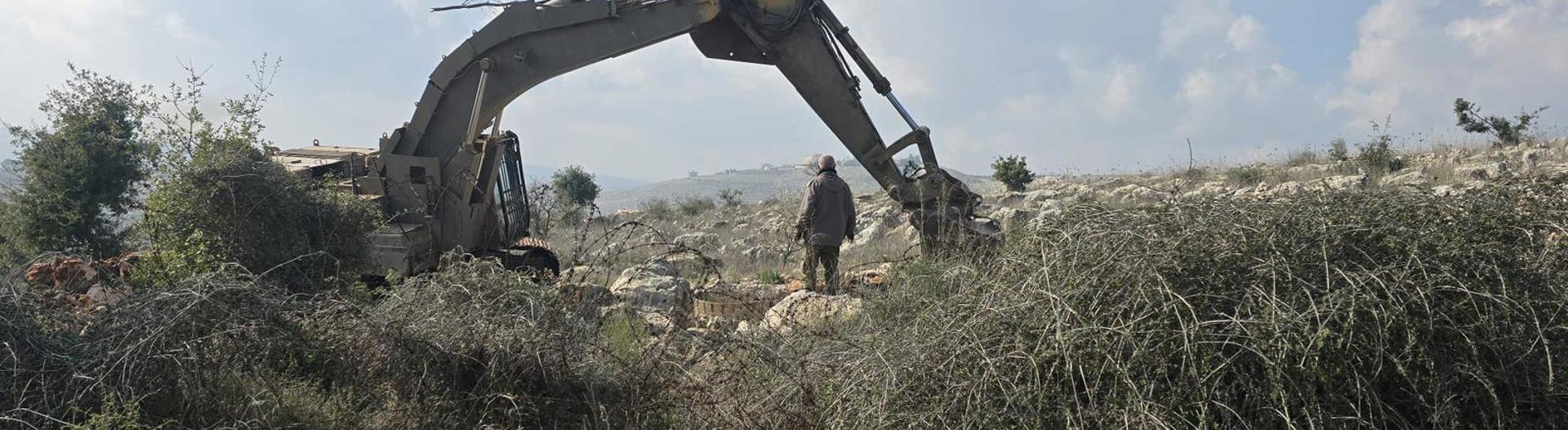
An Israeli military Excavator engaging in “exposure” work near the Israel-Lebanon border. March 2025. Photo: IDF Spokesperson Unit
The dozens of villages that Israel is currently destroying, along with their residents, have been in the eye of the storm of the Israeli-Palestinian conflict for nearly sixty years. From 1968 to 1982, it was primarily Palestinian organizations that used Lebanon as a base for operations against Israel as part of the armed Palestinian struggle. The Israeli response then as now, was based on military force: operations deep into Lebanon, airstrikes, and ground raids. The declared objective of these operations was to remove armed Palestinian organizations from Lebanon. They also included applying pressure on the Lebanese government by forcing the population in the south to leave their homes, including in the very villages that Israel is targeting today. Israel hoped that the human pressure and the humanitarian crisis would cause the government in Beirut to deal once and for all with the Palestinian challenge in the country. In practice, the opposite happened. Multi-ethnic Lebanon, which since its independence in 1943 was established as a weak state with weak state institutions, including the Lebanese army, could not cope with the challenge of the Palestinian organizations in the country, even if it wanted to. The result was the weakening of the state until its collapse with the outbreak of the civil war in 1975.
Operation Litani in March 1978, which was conducted in the exact same area that Israel is occupying today, was intended to push the Palestinian military threat north of the river. The operation’s failure led to the First Lebanon War in June 1982. The war’s ambitious goals included not only the elimination of the power of the PLO, which served as the umbrella organization for the armed Palestinian factions in Lebanon, but also establishing a new political order in the Middle East. Israel aimed to form a Lebanese government that would sign a peace agreement with Israel, and to force the Syrian army to withdraw its forces from Lebanon.The hope of the war’s architects —Menachem Begin, Ariel Sharon, and Rafael Eitan—was that a pro-Israeli Lebanese government established under the leadership of the new president, Bachir Gemayel, would expel hundreds of thousands of Palestinian refugees from Lebanon to Jordan with Israel’s encouragement. Thus, through a domino effect, the Palestinian national movement would direct its energy toward Jordan and overthrow the Hashemite regime, and Israel, for its part, would be able to complete its takeover of the territories it captured in 1967 and annex them.
The failure of this grand plan shifted the focal point of the Palestinian national struggle from Lebanon to the Occupied Territories. It also led Israel to remain in Lebanon for 18 years until May 2000, and to establish the security zone in the south of the country. In Lebanon, Israel relied on a local military force called the South Lebanon Army (SLA). The roots of this militia were already planted in 1976, when Israel assisted three enclaves of Christian villages to defend themselves against Palestinian and other militias during the Lebanese Civil War. The “Free Lebanon Army” was established under the command of Sa‘ad Haddad. Most of its soldiers came from Christian localities in southern Lebanon, primarily Marj‘ayoun, Debel, Ain ‘Ebel, Rmaish, al-Qlay‘a, and Alma al-Sha‘ab. Israel’s “Good Fence” policy along the Lebanese border during this period was designed to deepen this alliance through humanitarian aid to southern Lebanon, including granting work permits. It emphasized Israel’s power through the use of “soft power” and helped project a positive Israeli face to many residents of southern Lebanon.

Sa’ad Haddad, commander of the Free Lebanon Army, in a press conference in November 1981. Photo: Yosi Elmakis/Dan Hadani collection/National Library of Israel/The Pritzker Family National Photography Collection, CC BY 4.0, https://commons.wikimedia.org/w/index.php?curid=142358043
In 1984, the Free Lebanon Army changed its name to the “South Lebanon Army” (SLA). At the same time, its purpose also shifted and was defined primarily in relation to Israel’s security needs. No longer a local militia supported by Israel defending its villages against Palestinian organizations, the SLA became a military force whose primary role was to serve as a protective buffer for Israel within the security zone. To achieve this, the SLA’s areas of control had to be expanded from the Mediterranean coast in the west to the Hermon ridge in the east, while simultaneously broadening its recruitment circles. In June 1985, with the withdrawal of most IDF forces from Lebanon and the consolidation of the security zone, the human composition of the SLA began to fundamentally change. From then on, the majority of its soldiers were Shi‘ites, Sunnis, and Druze, with only a minority consisting of the militia’s original Christian core. Because its soldiers served close to the villages they came from, the SLA’s human composition reflected the demographic reality and the distribution of localities in southern Lebanon. Regiment 70, for example, in the Western SLA Brigade, was composed of Shi‘ite soldiers who came from Bint Jbeil, al-‘Adaissa, Houla, Markaba, Taybe, and others—all of which are Shi‘ite villages. Serving in the SLA provided not only relatively high salaries compared to the Lebanese market but also access to the Israeli labor market for the soldiers’ families. Thus, from the early 1980s until the year 2000, an average of about 3,000 Lebanese—Shi‘ites, Druze, Sunnis, and Christians—crossed the border daily to work in Israel. In fact, some of the residents of the villages that Israel is destroying today in southern Lebanon were partners in the security zone project until the withdrawal in May 2000. Some served in the SLA, and others made a living working in Israel.
The destruction and devastation that Israel is currently wreaking in southern Lebanon is directed mainly toward the Shi ‘a villages, which since the year 2000 have served as frontline bases for Hezbollah in its struggle against Israel. Most non-Shi‘a villages are not targets for destruction, even though some of them have been damaged by Israeli military activity. The strike on the Maronite village of Debel, which included the smashing of a cross and a statue of Jesus, garnered attention in Israel and around the world, while damage to Muslim religious buildings, including those classified as World Heritage sites, is mostly ignored by the Israeli media. Debel was one of the villages most closely aligned with Israel from 1976 onward. The military operations taking place there demonstrate how the callousness that drove the widespread destruction in Gaza, and which is now fueling similar actions in southern Lebanon, also involves overlooking or erasing Israel’s own history in Lebanon.

An aerial view of the Maqam Sham’oun al-Safa shrine in 2018. The shrine was heavily damaged in the 2024 Israeli invasion of Lebanon. It was then razed to the ground in an Israeli air strike on April 13, 2026. Photo: Ibrahim Amir Na’eem, CC BY 4.0
Israel is also threatening non-Shi‘a communities against allowing Hezbollah operatives into their areas. As a result, members of these communities deny even ordinary Shi‘a refugees of assistance out of fear of Israeli retribution. The inter-sectarian tensions in Lebanon are only worsening in the wake of Israel’s current offensive, and with them, the hostility toward Israel. In Lebanon, people take with the utmost seriousness the calls by extreme right-wing and messianic elements in Israel, including ministers and Knesset members, to unilaterally establish a new border for Israel along the banks of the Litani River, even if there is no practical feasibility for this. The widespread acts of looting by IDF soldiers in southern Lebanon, reported in both Israeli and international media, only add to the image of Israel as a society devoid of restraints, whose moral compass is broken. All this is happening during an unprecedented historical moment in Lebanon. For the first time in decades, both the government and many citizens support the disarming of Hezbollah and reaching an agreement with Israel to end the war, which would allow Lebanon to begin a process of political and economic reconstruction. However, the acts of destruction and the ongoing occupation of territories in southern Lebanon provide Hezbollah with exactly what it needs to justify its existence: an Israeli occupation of sovereign Lebanese lands, the killing of Lebanese civilians, devastation, ruin, and looting.
The vast contingent in Lebanon that desires Hezbollah’s disarmament, including the severing of its ties with Iran, and is ready to reach a political settlement with Israel, stands helpless in the face of Israel’s blatant aggression. This aggression diminishes the possibility of a stable future and normal relations between the two countries. The active military fronts in Gaza, Iran, Syria, and Lebanon, along with the ongoing ethnic cleansing in the West Bank, are integral pieces of a broader policy framework. The Gaza Model is transforming into Israel’s official strategy and declared policy. This stretches Israeli military aggression to its absolute limit. This hostility in turn blocks and postpones diplomatic solutions that could provide a positive horizon for Israel, the Palestinians, and the states of the region.
Asher Kaufman is a Professor of History and Peace Studies and the John M. Regan Jr. Director of the Kroc Institute for International Peace Studies in the Department of History and the Keough School of Global Affairs at the University of Notre Dame in Indiana.