UNRWA, the International Community, and Emergency Humanitarian Aid in the Occupied Territories: A Historical Perspective*
Maya Rosenfeld
Translated by Orit Schwartz
Since the outbreak of the war in Gaza on October 7, 2023, the survival of Gaza Strip inhabitants has depended primarily on emergency assistance provided by international aid organizations, led by UN agencies, which provide them with basic subsistence needs: drinking water, food, shelter, and life-saving medical services, among others.
This dependence on emergency aid has grown and intensified as Israel’s extended military onslaught on the Strip has prolonged, due to the cumulative impact of Israel’s methods of warfare. Incessant aerial bombardments of civilian population centers have caused the mass killing of at least 72,133 people as of March 9, 2026, approximately 3.25% of the population. Israel has systematically destroyed residential homes and public institutions, with over 80% of the buildings in the Gaza Strip damaged. The destruction included the health care system, the roads, water, electricity and sewage infrastructure, and led to repeated displacements of approximately 90% of the population. Additionally, Israel imposed sweeping prohibitions and restrictions on the quantity and content of incoming aid, including a complete ban on aid for two and a half months between March and May 2025. Israel has also carried out deliberate and repeated attacks on the personnel, institutions, and facilities of the aid organizations themselves. These widespread attacks have almost entirely stripped the people of the Gaza Strip of the private and collective resources they relied upon before the war, making emergency humanitarian intervention more critical than ever.
The apocalyptic dimensions of the humanitarian disaster have presented aid organizations with unprecedented difficulties and challenges. Yet the actors themselves were not new: the UN aid organizations that have been operating in the Gaza Strip since the beginning of the current war: UNRWA, the World Health Organization, UNICEF, the UN Office for the Coordination of Humanitarian Affairs, the World Food Program, and others, are the same organizations that provided emergency aid to inhabitants of the West Bank and the Gaza Strip from the early 2000s until October 7, 2023, against the backdrop of an ongoing socioeconomic and humanitarian crisis that prevailed in these territories throughout this period.
UNRWA, the United Nations Relief and Works Agency for Palestine Refugees, has been the cornerstone of emergency intervention throughout these decades, by virtue of being the largest, oldest, and most established aid organization, and the one responsible for the greatest number of service sectors operating in the occupied territories during normal times. The scale of emergency assistance it provided was many times greater and incomparably more diverse than that of all other organizations combined.
The ability to provide emergency assistance on a large scale and across a wide range of services stemmed from UNRWA’s unique position as an organization tasked with providing social and community services, primarily education and health, to millions of Palestinian refugees in the occupied territories, Jordan, Lebanon and Syria. This mandate distinguishes it from all other UN relief and development agencies and organizations, none of which is tied to a specific beneficiary population or provides social services to communities on a regular and ongoing basis.
The roots of its uniqueness lie in UNRWA’s history, which encompasses the history of Palestinian refugees, and some would argue, the entire Palestinian history since the 1948 war. UNRWA was established in December 1949 under UN General Assembly Resolution 302, in response to Israel’s refusal to implement Assembly Resolution 194, which called for the return of Palestinian refugees to their homes. Its purpose was to guarantee Palestinian refugees a recognized status and institutional assistance until a comprehensive solution to their situation was achieved, thereby embodying the international community’s commitment to them. It was designated a temporary organization, with its mandate subject to renewal by the General Assembly every three years. The enduring “temporary” nature of UNRWA, which recently marked its 76th anniversary, thus stands as testament to the international community’s continued failure to resolve the refugee problem. Over the years, the UN General Assembly has adopted a series of key resolutions anchoring the refugees’ right of return and compensation, the Palestinians’ right to self-determination, and their right to establish an independent state in the territories Israel occupied in the 1967 war, the West Bank, the Gaza Strip, and East Jerusalem. Yet, the international community has consistently refrained from employing the means at its disposal to compel Israel to implement these resolutions.
In my research on UNRWA, which I began more than three decades ago, I show that this ongoing failure of the international community has produced three major shifts in the agency’s pattern of action and its ability to influence the situation of refugees.
The first shift occurred in the 1960s, at UNRWA’s own initiative, as progress stalled on implementing UN General Assembly Resolution 194 concerning the return of Palestinian refugees to their homes. At the heart of the shift was a strategic plan that transformed UNRWA from a relief-focused agency, one whose main resources had been directed towards the regular supply of food packages, the construction of basic housing, the maintenance of refugee camp infrastructure, and the creation of temporary jobs, into an agency focused on educational services and the development of refugees’ human capital. UNRWA’s extraordinary investment in universalizing higher education among refugee communities and in training teachers in specialized colleges it established, at a time when government secondary education in Arab countries was still in its infancy. Within just a few years, this investment catapulted the educational achievements of refugee boys and girls to remarkable new heights. This leap, combined with access to higher education in government institutions of higher education in Arab countries, gave Palestinian refugees a distinct “educational advantage” over their local peers, one that was sustained for approximately three decades. These educational achievements paved the way for second- and third-generation refugees to professional employment, placing them at the forefront of developing labor markets, first in Jordan and later in the Arab oil states of the Gulf.
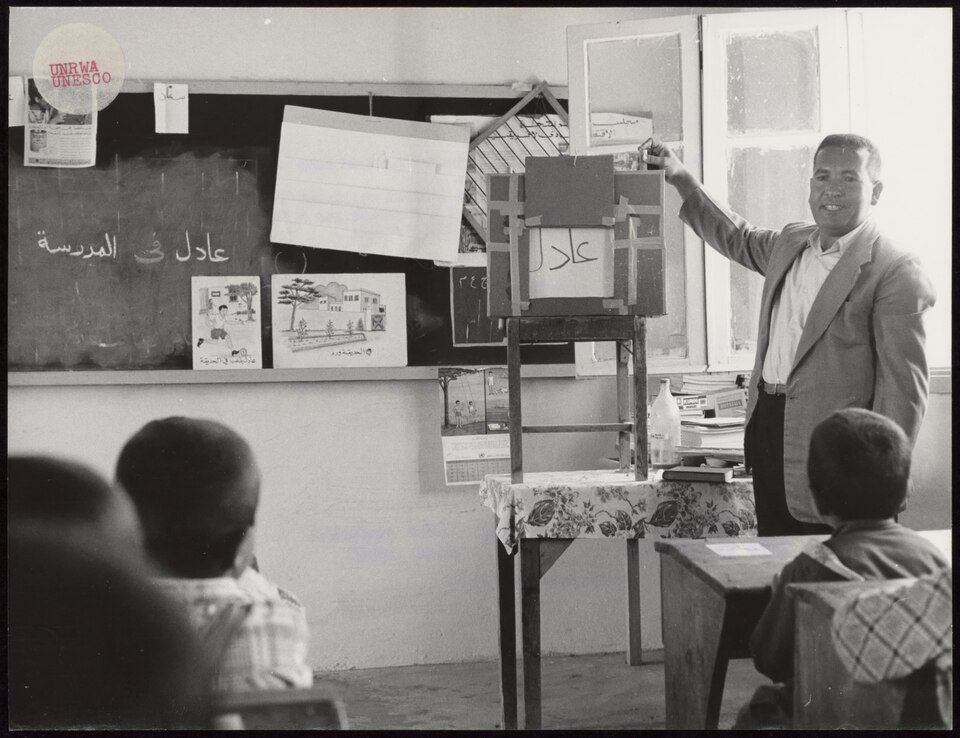
UNRWA’s education system continued to grow and develop. The share of education in the agency’s regular annual budget, which stood at a few percent in the early 1950s, rose steadily and stabilized at around 50%-60% from the 1980s onwards. The vast majority of the organization’s employees (between 65 and 70 percent) were teachers and education workers, virtually all of them graduates of the system itself. A parallel development, though with a far more modest budgetary investment, was recorded in the community health services, which grew increasingly professional and placed particular emphasis on family health, especially maternal and child health, and on the management of chronic diseases. By contrast, the share of relief assistance in the regular budget declined over the years to around 10% and was distributed sparingly to the neediest families designated as “relief cases”, who comprised only about 5-6% of all registered refugee families.
Despite its central role in the lives of Palestinian refugees, UNRWA was never an autonomous entity. Its existence remained dependent on voluntary contributions, its resources were limited, and its ability to improve the situation of refugees was contingent on geopolitical and economic circumstances. Education alone, despite its enormous potential, could not extricate refugees from their refugee status and the inherent vulnerabilities it entailed in labor markets. In the absence of their own nation-state, the realization of Palestinian educational achievements was conditioned by a multitude of factors beyond their control.
Israel’s occupation of the West Bank and the Gaza Strip in the 1967 war had far-reaching consequences for the Palestinian situation and for UNRWA’s operating conditions and capabilities. The military government Israel imposed on the peoples of these territories denied them access to resources and livelihoods, systematically neglected the public education and health systems, and prevented the development of modern infrastructure and social services.
UNRWA’s presence helped mitigate the harms inflicted by the occupation regime on refugee communities in the West Bank and the Gaza Strip. As a result, residents of refugee camps, as well as refugees living outside the camps, enjoyed better education and healthcare services than most residents of villages, towns, and cities, who were almost entirely dependent on the Israeli military government for public services. This notwithstanding, the agency’s institutions could absorb only a fraction of the tens of thousands of educated people whom the occupation had left without employment prospects.
The rise of the Palestinian national movement under the leadership of the Palestine Liberation Organization (PLO), and the widening international recognition of the Palestinians’ right to self-determination, prompted Israel to intensify military repression in the occupied territories and to launch large-scale military onslaughts against the PLO and its institutions in Lebanon. The two prime manifestations were the Israeli invasion of Lebanon in 1982 and the suppression of the First Intifada (1987-1992). Both wrought severe and widespread harm to the civilian population, and UNRWA was called upon to intervene and provide emergency humanitarian assistance to the affected refugees.
The signing of the Oslo Accords (in 1993, 1994 and 1995) and the establishment of the Palestinian Authority gave rise to high expectations for an end to the Israeli occupation regime in the West Bank and the Gaza Strip, the establishment of a sovereign Palestinian state in these territories, and the forging of full peace between the parties. Progression along this outline was also anticipated to provide the proper framework for resolving the refugee problem. Against this backdrop, many believed that UNRWA’s mandate would soon come to an end. The prevailing assumption was that the agency’s education and health services would be subsequently absorbed into those of the future Palestinian state.
In the first five years of its existence, the public sector established by the Palestinian Authority took in about 100,000 employees, became the primary employer in the West Bank and Gaza Strip, developed social services, and created an occupational horizon for tens of thousands of students and graduates of higher education institutions. Significant industrial development did not, however, materialize during this period, as Israel maintained its military control over areas designated as Areas B and C, which encompass most of the land reserves available to Palestinians in the West Bank. As a result, a substantial portion of the Palestinian workforce (approximately 20%) continued to depend on day-wage employment in Israel. Israel’s anticipated withdrawal from these areas was seen as key to the future development of modern infrastructure and industry. This notwithstanding, viewed broadly, the years 1995-1999, saw a trend of improvement across key socioeconomic indicators and, towards the end of the decade, a marked decline in unemployment.
The collapse of the Oslo Accords in the early 2000s, and the ensuing escalation of the conflict, marked the second historic turning point in UNRWA’s history. This turning point came as Israel abandoned its commitment to ending the occupation and to a political solution based on the partition of the land, acting instead systematically to foreclose the possibility of a viable Palestinian state in the West Bank and the Gaza Strip. The principal means it employed — imposing a closure regime on the West Bank, placing the Gaza Strip under siege, and launching a series of large-scale military assaults — caused unprecedented damage to the Palestinian economy and led to a steep decline of living conditions in both areas. Against this backdrop, UNRWA was forced to resume its role as a relief agency, providing emergency humanitarian assistance to the majority of the refugee population in the occupied territories (approximately 28% of West Bank and about 70% of Gaza Strip inhabitants are refugees). At the same time, it continued to operate its regular education and health services.
The severity of the crisis and its prolonged duration compelled UNRWA to establish a comprehensive framework of emergency programs to address the growing needs of an expanding affected population. To manage its aid operations, UNRWA issued emergency appeals every few months, which served as the basis for funding requests, addressing these to donor states and to the UN General Assembly. These were followed by progress reports, which tracked the actual implementation of the aid programs. The repeated appeals and follow-up reports thus served as an ongoing emergency fundraising mechanism, aimed at securing continuous funding for the agency’s dedicated emergency budget.
Each of the dozens of emergency appeals that UNRWA submitted between November 2000 and October 2023 was an extensive document that included several chapters: a comprehensive review, supported by up-to-date statistical data on the economic, social, and humanitarian situation in the occupied territories, with particular emphasis on the situation of refugee communities in the West Bank and the Gaza Strip; a detailed assessment of the acute needs of refugees suffering from loss of income, unemployment, food insecurity, loss of shelter, and loss of access to basic social services. The appeals further included detailed quantitative and qualitative tracking of progress in implementing emergency program targets, including cycles of food distribution, creation of temporary employment opportunities, financial assistance to the most vulnerable, repair and rehabilitation of homes, support to clinics and expansion of emergency health services, psychological support to children and adults, and more, as well as a detailed funding request for a specified time period. These then ‘routinized’ emergency appeals raised funding for six months or a year at a time. However, the major military onslaughts on the Gaza Strip (dubbed operations ‘Cast Lead,’ ‘Protective Edge,’ and others) compelled UNRWA to amend existing appeals and issue additional ’emergency-on-top-of-emergency’ appeals: that is, appeals dedicated specifically to Gaza Strip residents, over and above the original emergency appeal.
UNRWA’s emergency appeals, together with regular reports published by the Palestinian Central Bureau of Statistics, UN relief, development, and monitoring organizations, research institutes, and human rights organizations, provided current and comprehensive documentation of the impact of the closure regime, the siege, and the military assaults on Palestinian society in the West Bank and the Gaza Strip. Yet this vast documentation enterprise did not move the international community to intervene, neither to provide protection to inhabitants of the occupied Palestinian territories nor to prevent Israel from continuing to implement its policies. The international community contented itself with continued funding of emergency assistance for the victims of these policies, and even that grudgingly, while donor responsiveness to UNRWA’s emergency appeals declined steadily throughout the period, in inverse proportion to the growing need for assistance.
An examination of the agency’s consecutive emergency appeals shows that UNRWA demonstrated an uncompromising commitment to the refugee communities in the West Bank and Gaza Strip and invested extraordinary efforts to meet their needs and protect the rights of the most vulnerable: children, youth, pregnant women and new mothers, the elderly, the chronically ill, and the injured. But the scope of assistance it was able to provide was limited from the outset and shrank due to chronic underfunding as the crisis worsened over time. The decline in donor response forced UNRWA to prioritize the urgent needs of Gaza residents and the emergency food program above all else, cut back on many of its other emergency programs, and to lower expectations. This created a widening gap between the scope of assistance required by the affected population and UNRWA’s ability to provide it, rendering its emergency intervention increasingly ineffective.
The emergency intervention thus immersed UNRWA in a Sisyphean task and weakened its position vis a vis the international community. The latter, meanwhile, refrained from taking steps that would restrain Israel and continued to place the burden of aid on UNRWA’s shoulders. This preference de facto exempted Israel from responsibility for the destruction of the Palestinian economy and the ensuing socioeconomic and humanitarian crisis and contributed to the perpetuation of a “status quo” that was ultimately shattered on October 7, 2023.
The third turning point occurred during the current war in Gaza, during which Israel shifted from a strategy aimed at preventing the feasibility of a Palestinian state in the West Bank and the Gaza Strip to a strategy of annihilation, namely, to a comprehensive assault on the very existence of the Palestinians in these territories. UNRWA’s status as the pillar of support for Palestinian refugees and as a symbol of the international community’s commitment to their cause, and above all as the principal provider of social services and emergency aid to residents of the Gaza Strip, made it simultaneously a target for attack and dismantlement.
Israel’s war of annihilation forced UNRWA to move from an emergency intervention that helped about a million and a half refugees living in the Gaza Strip survive an ongoing acute crisis, to an emergency intervention that focused on saving their lives. The incessant bombings turned most aid recipients into internally displaced persons fleeing for their lives. To address their plight, UNRWA converted about 150 of its schools into shelters that accommodated hundreds of thousands of displaced persons (in the winter of 2024, they sheltered nearly a million people). It provided those sheltering in makeshift shelters and camps with drinking water, food, winter equipment, and basic sanitation services. It opened dozens of emergency medical centers and operated mobile medical teams, emphasizing particularly vulnerable populations – infants, children, pregnant women and new mothers, people with chronic diseases, and the elderly. Hundreds of its social workers and educational counselors provided psychological support to tens of thousands of children and parents across various group settings.

The agency’s emergency and rescue teams, institutions, and facilities, including dozens of schools that were converted into mass shelters, were repeatedly struck by airstrikes throughout the war, resulting in thousands of casualties and catastrophic physical destruction. As of March 18, 2026, 391 UNRWA employees had been killed in Israeli attacks: 310 were agency staff and 81 were service providers and volunteers. Of these fatalities, 15 were killed during aid and rescue operations and the remainder in indiscriminate attacks. Of the 320 UNRWA facilities in the Gaza Strip, 312 were hit in 963 military strikes, including schools converted into shelters, schools not used as shelters, clinics, warehouses, and offices. At least 853 people sheltering in UNRWA facilities were killed and at least 2,588 were injured. Some 75% of the structures struck were destroyed or severely damaged, leaving them unusable.
Furthermore, at the end of October 2024, the Knesset approved the ‘Law for the Cessation of UNRWA Activities – 5785’, comprising a prohibition on the agency operating on Israeli territory, a severance of all working ties with it, and the revocation of immunity for its employees. Although the occupied territories are not part of Israel’s sovereign territory, its military control over the Gaza Strip and the West Bank, combined with the weakness of the international response, has allowed it to impose the law in these areas as well. Indeed, since March 2025, when Israel breached the second ceasefire agreement with Hamas, it has completely barred UNRWA from bringing aid into the Gaza Strip and prohibited the agency’s international staff from entering. This ban persisted at the time of writing, (March 2026), more than five months after the the signing of a subsequent ceasefire agreement on October 10, 2025.
While UNRWA has remained the mainstay of international emergency aid throughout the war, the implementation of the law suspending its operations has dealt a potentially irreversible blow to the agency and the millions who depend on it.
Between Israel’s breach of the ceasefire in March 2025 and the current ceasefire that began in October, Israel launched three devastating military operations, two in central Gaza and one in Gaza City. These resulted in the killing of more than 18,500 people, the injury of tens of thousands, the destruction of thousands of homes and buildings, and the displacement of hundreds of thousands from wherever they had taken shelter. UNRWA’s capacity to assist the masses of victims has steadily diminished. In April 2025, its warehouses ran out of flour and food. In the months that followed, the food crisis in the Gaza Strip deepened sharply, with famine spreading and the number of deaths from starvation rising, all this while hundreds of the Agency’s trucks, loaded with food supplies were being held up at the crossings. UNRWA’s stocks of medicines and medical equipment were severely depleted, and its emergency teams’ access to the injured and those in need in Gaza City was almost completely blocked.
Immediately after the current ceasefire came into effect, UN aid organizations launched a 60-day emergency advance plan, designed to jump-start the provision of basic necessities and services to Gaza Strip residents before long-term rehabilitation could begin. The agreement ostensibly obliged Israel to allow a massive influx of all humanitarian supplies without delay. In practice, Israel drastically limited the quantities and content of aid, particularly medical supplies, provisions for repairing and protecting shelters, and equipment for debris removal, thereby preventing the initial rehabilitation of the health system and physical infrastructure. Hospitals and clinics continued to suffer from an acute shortage of medicines, equipment, and medical supplies. Israel also refused to allow tens of thousands of wounded and sick people urgently requiring medical evacuation to leave the Gaza Strip – the Rafah crossing remained closed until February 2, 2026, and even afterward, exit permits for the wounded and sick were granted only sparingly. Israel prevented the entry of prefabricated housing units and severely restricted the entry of tents, leaving close to one million displaced people without adequate shelter. UNRWA, with thousands of trucks loaded with food, medicine and equipment, once again waiting at the Gaza border, was targeted once again: Israel continued to bar it from bringing supplies into the Gaza Strip, stripping the international aid system of one of its central pillars.
At the same time, in flagrant and systematic violation of the ceasefire, Israel continued its daily lethal attacks across the Gaza Strip, killing 680 people and wounding 1,814 by March 18, 2026, and causing extensive further destruction. As if this were not enough, a series of winter storms struck the Gaza Strip between November 2025 and January 2026. The storms repeatedly flooded the displaced persons’ camps with rainwater and sewage, devastated thousands of tents and their meager contents, and exposed tens of thousands of people to bitter cold and related illnesses. Even under these conditions, Israel persisted in refusing to allow prefabricated housing units or the heavy equipment necessary for infrastructure work to enter the Gaza Strip.
Israel’s violent actions succeeded in derailing the UN aid organizations’ preliminary emergency plan and preventing its leaders from meeting the threshold targets they had set. Thus, the months of the first phase of the ceasefire agreement passed without any significant improvement in humanitarian indicators in the Gaza Strip, with only marginal gains in access to clean water and food, and without any outline for rescue from the catastrophic situation. Israel’s deliberate sabotage of the UN’s 60-day plan is a direct continuation of its campaign to dismantle UNRWA and an integral part of its war of annihilation in the Gaza Strip. The inter-connection between strategy, goals, means, and results has never been clearer. And yet, the international community continues to refrain from taking the necessary steps that would end Israel’s control over humanitarian aid and the fate of its recipients. Instead, it is contenting itself with symbolic expressions of support for UNRWA and its “indispensable” role . Only recently, in December 2025, were these sentiments translated into a General Assembly resolution extending the agency’s mandate for another three years, and a separate resolution praising UNRWA’s work and strongly condemning Israel’s actions against it, both passed by an overwhelming majority. The gulf between the international community’s declarations of support and its willingness to act on them could hardly be greater.
Dr. Maya Rosenfeld is a sociologist and anthropologist who studies the social and political history of the Palestinian people in the occupied territories and in the Arab diaspora. She teaches in the Department of Political Science at the Hebrew University and in the Department of Administration and Public Policy at Sapir College.
* My research on UNRWA grew out of my doctoral thesis, which examined processes of social and political change in a Palestinian refugee camp under the Israeli occupation regime. During fieldwork I conducted in the Dheisheh refugee camp from 1992 to 1996, I observed firsthand the central contribution of UNRWA’s education system to the upward social mobility of second- and third-generation men and women. This led me to research the history of UNRWA itself, in order to understand how it transformed from an agency identified with the monthly distribution of the “sack of flour” into one whose flagship was education and the promotion of professional employment opportunities. I returned to my research on UNRWA in the 2000s, amidst the closure and siege regime that Israel imposed on the West Bank and the Gaza Strip, and the sharp deterioration in socioeconomic conditions that resulted from this policy. Most of the refugee population in the occupied territories had become dependent on emergency humanitarian assistance, and UNRWA had returned to providing relief assistance to hundreds of thousands of households. My focus turned to the tension between UNRWA’s commitment to developing refugees’ human capital and its obligation to provide relief assistance that was survival-oriented in nature. The current war in Gaza, in which Israel has shifted to a strategy of annihilation, has rendered the services of international aid organizations in general, and UNRWA’s in particular, critical and lifesaving, while simultaneously making UNRWA itself a target for Israeli attack. My most recent research project, supported by the Children and Youth Rights Program of the Minerva Center at the Hebrew University, examined UNRWA’s declining ability to fulfill its mandate from October 2000 to October 2023, and even more so under the conditions imposed by Israel’s war of annihilation in Gaza. This article draws primarily on findings from these three research projects.
Further reading:
On UNRWA’s shift from a relief-focused agency to an education-focused agency, and its long-term implications for the educational and employment characteristics of refugees, see:
Rosenfeld, Maya. “From Emergency Relief Assistance to Human Development and Back: UNRWA and the Palestinian Refugees, 1950–2009.” Refugee Survey Quarterly 28, no. 2-3 (2009): 286–317.
On the success of UNRWA’s education system in “mitigating” the harm inflicted by the Israeli occupation regime for refugees residing in the occupied territories, in the areas of educational services and the employment opportunities of educated professionals, see:
Rosenfeld, Maya. Confronting the Occupation: Work, Education and Political Activism of Palestinian Families in a Refugee Camp. Stanford: Stanford University Press, 2004: 119-131; 157-166.
On UNRWA’s emergency operations in Lebanon following the Israeli invasion of 1982-3, and UNRWA’s emergency assistance to the residents of the occupied territories during the first intifada, see:
UN General Assembly, Report of the Commissioner-General of the United Nations Relief and Works Agency for Palestine Refugees in the Near East: 1 July 1982–30 June 1983, Official Records, Fifty-fifth Session, Supplement No. 13, A/38/13 (September 16, 1983): paras. 1-45.
UN General Assembly, Report of the Commissioner-General of the United Nations Relief and Works Agency for Palestine Refugees in the Near East: 1 July 1988–30 June 1989, Official Records, Fifty-fifth Session, Supplement No. 13, A/44/13 (October 2, 1989): paras. 120-125.
On the development of the relations between the PLO and UNRWA and the shared working assumptions of both parties following the signing of the Oslo Accords and the establishment of the Palestinian Authority, see:
al-Husseini, Jalal. “UNRWA and the Palestinian Nation-Building Process,” Journal of Palestine Studies 29, no. 2 (Winter 2000): 51–64.
On the development of the Palestinian public sector and on the Palestinian Authority’s development policy during the Oslo years (1994–2000), see:
Rosenfeld, Maya. “On the Contribution of the Palestinian Authority to the Formation of a New Middle Class in the Occupied Palestinian Territories: 1994-2017” (paper presented at the 57th Annual Meeting of the Middle East Studies Association of North America [MESA], Virtual Meeting, November 13–19, 2024).
On the socio-economic crisis caused by the military measures employed by Israel in the occupied territories from October 2000 onward, see, for example, the following reports:
World Bank, Twenty-Seven Months—Intifada, Closures and Palestinian Economic Crisis: An Assessment. Washington, DC: World Bank, 2003.
UNRWA, Prolonged Crisis in the Occupied Palestinian Territory: Socio-Economic Developments in 2007. Gaza: UNRWA, July 2008.
For UNRWA’s emergency appeals and progress reports on the implementation of emergency operations, see the full collection of reports:
UNRWA, Emergency Appeals and Emergency Appeals Progress Reports, 2000–2023. Gaza, Amman, and East Jerusalem: UNRWA, 2000–2023.
Available at www.unrwa.org
On UNRWA’s emergency operations and an assessment of its capacity to respond to the socioeconomic crisis that prevailed in the occupied territories between October 2000 and October 2023, see:
Rosenfeld, Maya. Progress Report – When Providers of Assistance and Protection are Prevented from Fulfilling their Mandate: Evaluating UNRWA’s Ability to Provide the Basic Needs of Palestinian Refugees in Times of Protracted Emergency and War. [Manuscript in preparation]. 2026.
For UNRWA’s regular reports documenting the humanitarian situation in the Gaza Strip and its emergency relief operations since the start of the war in Gaza (October 2023) to March 18, 2026, see:
UNRWA, Situation Reports on the Humanitarian Crisis in the Gaza Strip and the Occupied West Bank including East Jerusalem, Nos. 1–213. Gaza and Amman: UNRWA, October 2023–March 2026.
The reports are available at www.unrwa.org
On the 60-day plan announced by UN aid organizations in the Gaza Strip immediately after the October 2025 ceasefire came into effect, see:
United Nations Office for the Coordination of Humanitarian Affairs (OCHA). “UN Relief Chief Outlines 60-day Plan to Deliver Vital Aid after Gaza Ceasefire.” October 9, 2025. https://www.ochaopt.org/content/un-relief-chief-outlines-60-day-plan-deliver-vital-aid-after-gaza-ceasefire