Drone Warfare and the Destruction of Gaza
Part 1 – Drone Swarms and the Erasure of Personhood
Shiri Krebs
Mahmoud Almadhoun, or Chef Mahmoud as he was known by many, operated a soup kitchen that fed hundreds of families in Northern Gaza. He was killed on November 30, 2024, by a direct strike. His family reported seeing a drone buzzing around the house before his killing. A year and a half later, that’s all we know. His family does not know why he was killed, or who or what killed him; they don’t know whether Mahmoud was killed by accident or as a result of an identification error, or whether he was the intended target of a planned attack. Without access to the surveillance drone data, his killing remains arbitrary, unaccounted for, and unexplained.
In her poem, Hunger Camp at Jaslo, Wislawa Szymborska wrote:
History counts its skeletons in round numbers.
A thousand and one remains a thousand,
as though the one had never existed
Drone swarms count their skeletons as targets, erasing who they are; their stories, their identities, their existence. Algorithms do not provide explanations, they are incapable of reflection, and they have no intent.
In this 2-part essay, I explore three elements in drone warfare that explain their role in erasing Palestinians’ personhood and legitimizing the destruction of Gaza. This part of the essay focuses on how digital sensing leads to the avatarization of people and places, and considers the implications of swarm technology for human judgment and decision-making. The second part explores how digital capabilities change the meaning of core International Humanitarian Law (IHL) norms, playing a part in the collapse of established limitations on organized armed violence.
Avatarization
I use the term ‘Avatarization’ to describe how digitized systems collect and analyze information about people during armed conflicts. The transition from human-centered collection and analysis of intelligence to automated, AI-powered, predictive intelligence means that individuals are reduced to variables that can be coded. People are seen through a technical lens that reproduces them as something similar – but not identical – to who they are. For example, an infrared lens makes some information or details (like movement of figures) visible during nighttime operations, but at the expense of other details (like color detection, which may be crucial in armed conflict scenarios, where some protected symbols, such as the red cross, require color-detection capabilities).
Drone swarms and AI-powered algorithms further contribute to the avatarization of people through the type of information they collect: rather than positive data about a particular individual (Yasmin was seen moving ammunition to a Hamas compound), AI-powered data collection processes focus on probabilistic red flags: network associations (Yasmin’s phone contains saved numbers of other individuals suspected to be connected to Hamas), metadata (specific patterns of data, like short, frequent calls or messages at unusual hours, or frequent switching of accounts), geolocations (Yasmin’s location was detected near known Hamas members or locations associated with Hamas), and other statistical risk factors and correlations. These types of data create new knowledge about people in armed conflict areas, but also degrade the image we construct of them, and carry an inherent risk of false positives (erroneously identifying as a high risk someone who does not pose any risk, simply because they ticked some of the probabilistic red flags, each of which may be explainable on its own).
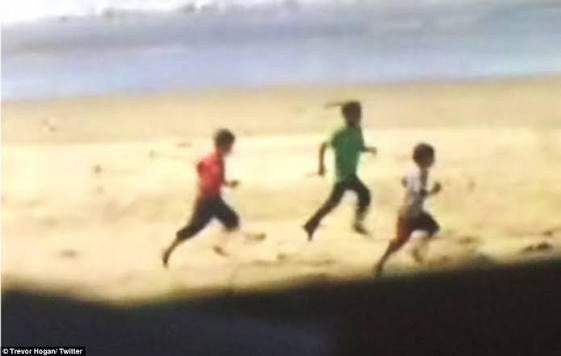
Another factor contributing to avatarization is the separation of image and audio in drone surveillance, which alters how our brain processes and interprets what we see. While a drone lens allows zooming in and provides visuals of the ground from a great distance, these visuals do not include the sounds that accompany them in real life, thereby preventing accurate interpretation. Of course, the vertical lens in itself changes our view of the ground, limiting our ability to detect someone’s height, and potentially affecting our ability to distinguish between children and adults. This was the reason given by the Israeli military for the lethal targeting of four young children on Gaza beach – Isma’il Bakr (9 years old), ‘Ahd Bakr (10 years old), Zakariya Bakr (10 years old), and Muhammad Bakr (11 years old) – on July 17, 2014. The four children were killed by two missiles that were fired at them after a drone team identified them as adult Hamas combatants. A military investigation cleared the soldiers involved in the killing of any wrongdoing based on the fact that, from a drone lens, it was impossible to distinguish between children and adults. A more recent example is the Israeli military attack on several ambulances near Tel Al Sultan in March 2025; an attack that killed fifteen paramedics and rescue workers. While initially claiming that its forces attacked Hamas operatives, the military eventually had to acknowledge – after a video footage of the killing emerged, filmed by Rif‘at Radwan, a paramedic who was killed in the attack – that those killed were paramedics and rescue workers. In seeking to explain and justify this slaughter, the military stated, that the attack was launched based on data from a surveillance drone, which identified “five vehicles approaching rapidly,” creating a perception of an imminent threat that required an immediate response. In both cases, surveillance drones reduced and framed human beings—children and rescue workers—as threats that had to be eliminated immediately.
Palestinians’ humanity is further jeopardized by drone technologies, as the type of data they collect and communicate often dehumanizes those surveilled. For example, some data processed by drone technologies is not usually associated with descriptions of human beings, such as using temperature signatures or movement signals to detect people. Other data includes numbers that cannot describe or count people in any meaningful way, such as fractions and decimals, like anticipating that 3.7 people will be killed as collateral damage.
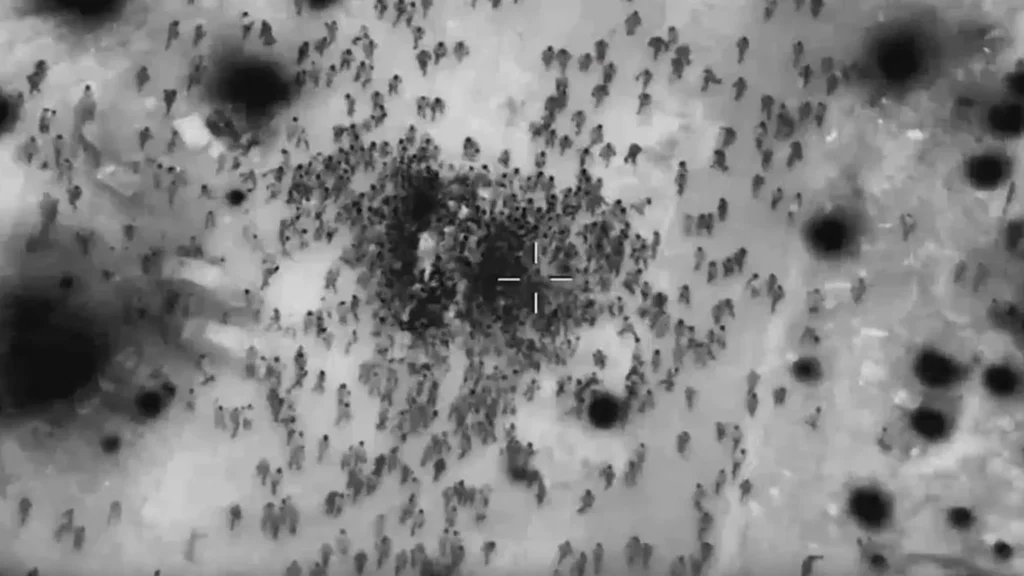
Drone technologies also create a significant distance between military decision-makers and their victims. The image above was released by the Israeli military as a justification for a lethal attack on aid trucks in March 2024. This image was used by the military to justify its attack on aid-seekers, by depicting them – men, women, children, elderly, pets – through the drone lens, as an unrecognizable, threatening mass (or swarm), depriving them of their individuality and humanity.
Swarms vs Humans
Drone swarms are designed to mimic human behavior, generating human-like practices that are faster, stronger, at a larger scale, than human performance. They therefore create military advantages in response time and data analytics capabilities. However, these advantages come at a price: we lose, and even devalue, unique human capabilities. Drone swarms are incapable of applying common sense (or adapting to new contexts based on cultural nuance and sensitivity). They are also incapable of reflection and reflexivity, or of applying human reasoning to make life-or-death decisions. These differences lead to a move away from human-based reasoning and reflexivity toward a technical approach to military errors, based on error rates and design flaws; a move away from sensitivity to context and changing circumstances toward probabilistic inferences and network connections.
Speeding up wars through the power of drone swarms further escalates the gap between the cognitive capabilities of humans and the processing volume and speed of war machines. While startups like the drone company Xtend promise to improve military capabilities through a fleet of hundreds of drones controlled by a single individual (‘human-guided autonomous systems’), it is now clearer than ever that no human has the necessary cognitive abilities to provide meaningful guidance to hundreds of war robots, awaiting their orders.

Returning to the killing of Mahmoud Almadhoun: Mahmoud, a humanitarian from Northern Gaza, provided food to hundreds of families in Beit Lahia and to patients at Kamal Adwan Hospital. On November 30, 2024, Mahmoud was killed by a direct strike, mere meters from his home. His family reported seeing a drone buzzing around the house before he was killed. A thorough investigation by Yassin Musharbash, a journalist from the German newspaper Die Zeit, attempted to find out why and how Mahmoud was killed. While eyewitnesses and family members can recount Mahmoud’s life and the devastation left in the attack’s wake, the reasons for his killing remain unknowable. Without access to the drone’s surveillance data or insight into the targeting process, his death remains unexplained – an arbitrary act of violence without an identifiable reason or accountable actor. Was he killed intentionally or by mistake? Was he targeted based on real-time surveillance, or was his death the result of a pre-planned operation? Who made the decision? Will anyone be held accountable? Will anyone feel remorse?
Mahmoud’s family will likely never know. All they are left with is the constant buzzing of the drones.
Shiri Krebs is a Professor of Law and the Director of the Centre for Law as Protection at Deakin University, Melbourne, Australia. She is also an Experienced Alexander von Humboldt Research Fellow at Hamburg University, and an Affiliate Scholar at the Stanford Center for International Security and Cooperation (CISAC). This essay is based on research funded by the Australian government through the Australian Research Council (DE230101646).